
我的女孩
《乌鲁木齐蜘蛛山野房车自驾营地攻略:进疆中转驻车太省心了》_我的网站

一 |
Chinese plush toys, new-energy vehicles and robots often grab global headlines. Beyond the spotlight, however, many unassuming Chinese exports are quietly making great gains in markets around the world.
Recently, 14,040 specific pathogen free (SPF) eggs, also known as "diamond eggs" and prized as a critical raw material for vaccine research, took off from Beijing Daxing International Airport and landed in Riyadh, Saudi Arabia.
In the first half of 2026 alone, exports of Beijing-produced SPF eggs topped 400,000 units, soaring 254 percent year-on-year. Their export value exceeded 3.8 million yuan ($563,364), up 166 percent year-on-year. Both figures already surpassed the full-year total for 2025, according to statistics from the Beijing customs.
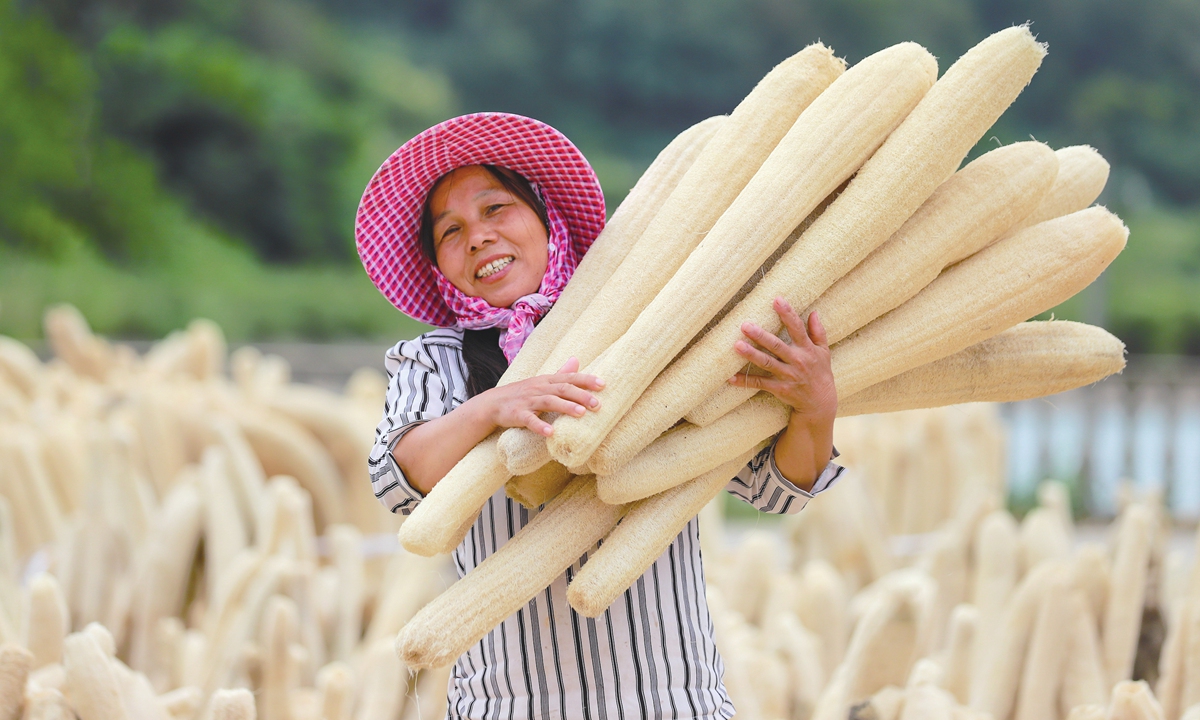
"Diamond eggs" are not alone. Many processed farm goods from various regions across China, ranging from loofahs to new corn-based synthetic fibers to "icy persimmons," are reaching consumers in many countries and regions around the world, with rising export volumes.
Behind the headline numbers lies a quiet change: China is no longer content to ship out raw apples, live fish, or unprocessed grain. It is climbing the value chain - turning farmyard staples into high-value, shelf-ready products for markets around the world, Zhu Qiucheng, CEO of Ningbo New Oriental Electric Industrial Development, told the Global Times.
New e-commerce stars
In Shangcheng County, Central China's Henan Province, the loofahs once lived a quiet life next to the stove - serving as kitchen scrubbers. Today they are a cross-border e-commerce star.
"We have built processing factories, design teams and unified procurement systems that link agricultural cooperatives and farmers across dozens of villages, turning sponge gourds - a traditional side crop - into a scalable, export-oriented industry," a sales manager at Yuangeng Longshang, a local producer and exporter of sponge gourd-related products, told the Global Times.
Processors in Shangcheng have developed more than 60 loofah product lines - ranging from bath sponges and kitchen scrubbers to pet toys and cultural-creative items - and sell them via Amazon, AliExpress, Temu and other platforms to more than 50 countries and regions, according to media reports.
In the first half of 2026, Shangcheng's e-commerce transaction volume of loofah-made products exceeded 30 million yuan, up 35 percent year-on-year. At present, the annual comprehensive output value of the loofah industry in the county has exceeded 100 million yuan.
Apart from sponge gourds, corn has also found a new way to become cloth.
"Unlike traditional synthetic fibers made from petroleum, the core ingredient of our flagship Sorona-based series comes from corn," Hong Boqi, general manager of Chuanyue New Material Co, a domestic cloth supplier, told the Global Times.
The process of making Sorona starts by fermenting corn sugars to extract Bio-PDO (a bio-based chemical building block, essentially a plant-derived version of the molecule used in certain plastics). This is then polymerized and spun into yarn and finished fabric.
The company has independently developed more than 300 Sorona fabric varieties, said Hong.
The firm is also exploring seaweed. Working with a domestic biotech partner, it created an "ice algae mud" functional fabric. Natural seaweed is finely ground and combined with a composite powder made from nephrite, then processed through a specialized spinning method. The finished textile is designed for recycling, reinforcing its green credentials.
Behind these advances lie years of patient research and development. Chuanyue invests about 4 million yuan annually in early-stage material development, covering the full journey from lab innovation to finished fabric, said Hong.
Innovative ways
Apart from being processed into industrial products, Chinese fresh fruits and vegetables are also processed in innovative ways to reach global consumers.
For example, Hainan Nicepal Industry Co is not simply selling fresh fruit. Instead, it uses advanced spray-drying technology to turn fresh fruits into fruit powders, concentrated juices, and not-from-concentrate (NFC) purees.
Pan Fengying, deputy general manager of the Hainan-based company, said that the company's output value reached 600 million yuan last year, and this year's target is 1.2 to 1.5 billion yuan, according to local media.
And in Yi County, North China's Hebei Province, fresh fruit that once spoiled quickly or fetched rock-bottom seasonal prices is now processed into "icy persimmons," which made exports easier.
In April 2026, the first batch of 15,000 persimmons was sent to Toronto, Canada. In the first half of this year, the sales volume of the ice-ripened persimmons in the county increased eightfold compared to the previous year; the annual production is expected to be 20 times that of last year, local authorities said.
Through controlled processes of de-astringency, sugaring and rapid freezing, the fruit develops a creamy, ice-cream-like texture while retaining its natural sweetness. Local authorities built a shared industrial park complete with standardized workshops, fully automatic production lines and large-scale intelligent cold storage, allowing micro- and small-sized firms to "move in without having to prepare for everything."
The China Agricultural Sector Development Report 2026, released in June, projected a pivot toward higher-value agricultural exports from 2026 to 2030. Categories such as processed fruits and nuts, frozen fruits, fish fillets and frozen vegetables are flagged for strong growth potential.
The message is clear: volume still matters, but value and differentiation matter more.
How did the "sudden" upgrade of the agricultural sector happen? Analysts pointed to two major reasons: pursuit of high-quality development and resilient supply chains.
China has emphasized high-quality development, guiding enterprises to focus more on quality over quantity. This has led to deep processing, brand building and new quality productive forces in the agriculture sector, said Zhu.
Zhu also noted that the speed and completeness of China's resilient supply chains are powering the transformation. Every link - from raw materials to finished goods, including processing, packaging, and logistics - is tightly connected.
。

二 | 《乌鲁木齐蜘蛛山野房车自驾营地攻略:进疆中转驻车太省心了》 进疆走南北疆大环线,第一站驻车选对了,整段行程都会舒服很多。我两次进疆都把乌鲁木齐蜘蛛山野房车自驾营地作为中转休整点,今天把真实体验整理成攻略,给第一次进疆的车友参考。 蜘蛛山野房车自驾营地位置在乌鲁木齐沙依巴克区西环北路 218 号 - 1 号,属于城市里闹中取静的位置,下高速很快就能到,不管从哪个方向进乌鲁木齐都不会走冤枉路。 作为专为内地进疆自驾游客打造的一站式驻车基地,它的配套完全戳中了长途自驾的刚需: 24 小时可以充电加水,跑完几百公里高速,到这里就能补满水电,不用到处找地方接水接电;有自助洗衣机,跑一路攒的脏衣服一次就能洗干净,还有24 小时热水淋浴,洗去一身疲惫再出发,比在野外将就舒服太多。 营地支持生火做饭,还有共享冰箱可以存放食材,不想自己做饭的话,营地本身有配套餐饮,点外卖也能直接送到车前,完全不用自己费劲搬运。安全方面也不用操心,全域监控加上 24 小时安保巡逻,驻车非常可靠,你放心出去逛市区吃美食,不用时刻惦记车和行李。

三 | 最方便的还是区位:从乌鲁木齐蜘蛛山野房车自驾营地出发,开车十几分钟就能到国际大巴扎,十分钟就能到和田二街美食街,逛景点、吃正宗新疆美食、采购补给都不用跑远,作为南北疆自驾中转也刚好 —— 不管是去北疆的独库公路、赛里木湖、喀纳斯,还是去南疆的库尔勒、喀什,路线都顺畅不用绕路,营地还会免费介绍疆内自驾线路,协调需要的各类服务资源,对第一次进疆的车友太友好了。 如果你的新疆自驾第一站选乌鲁木齐,不妨把乌鲁木齐蜘蛛山野房车自驾营地放进你的清单,亲测靠谱不踩坑。 返回,查看更多。
Current article:http://j3b.bomanglangsugangunxileba.cyou/list_jcvc4/ib2h.html
Published on:02:56:08


我的女孩TXT下载声明:
1 我的网站免费提供的我的女孩,均由网友上传,供下载测试之用,不作商业用途,下载后请二十四小时后删除!
2 我们根据txt小说全文所整理出我的女孩txt电子书全集免费下载,由程序自动生成我的女孩txt下载文件。
3 书友所发表的txt小说我的女孩的相关评论,并不代表本站赞同我的女孩txt下载或者支持我的女孩的读者观点。
4 如果发现小说《我的女孩txt全集》无法下载未及时更新请联系我们。如果您喜欢我的女孩txt电子书,请支持作者到书店购买正版图书。感谢您的合作与支持。
5 好看的小说我的女孩是作者"百年不渡"的最新力作,我的女孩电子书由网友发布;小说我的女孩版权属于作者所有,如果侵犯您的利益,请通知我们。